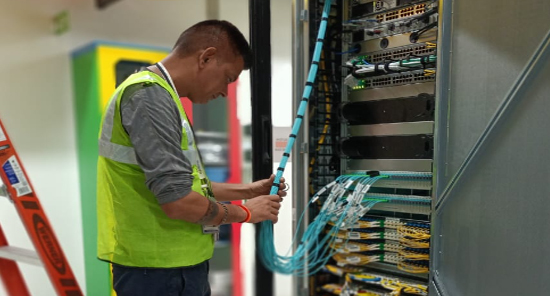
Fibre · Buyer guide
A fibre backbone quote can look complete while leaving the optical modules for somebody else to select. That gap matters. The installed cable, patching and transceivers must support the same intended application. Review the whole path between the two devices before comparing the cable price.

Begin with the application and endpoints
Record what connects at each end, the required link speed, the surveyed route length and the expected service life of the installation. Include future requirements as separate design cases rather than turning them into an unexplained instruction to “future-proof”.
Belden’s discussion of single-mode and multimode transceivers connects the optical choice with the fibre medium and application. Belden: fibre and transceiver selection For a purchase decision, take the next step: identify actual compatible optics for the endpoint devices and verify their stated requirements against the proposed installed path.
Draw every connection in the path
Show the transceiver, equipment patch cord, panel or enclosure, permanent fibre, intermediate splices or connections, far-end panel and far-end optic. Record the connector and polish type at each relevant interface. A matching connector shape does not establish that every other characteristic matches.
Ask who supplies each item. An excluded pair of optics, missing adapters or additional patching can leave a quoted cable system unable to form the required live link. Assign installation, configuration and acceptance ownership rather than allowing all three to fall into a gap between contractors.

Choose the cable for its environment too
The fibre designation alone does not describe the cable construction. The route may involve risers, outdoor sections, moisture, mechanical exposure or building requirements that need a suitable cable and installation method. Confirm transitions between environments instead of selecting from jacket colour.
Belden’s FDSH048LD is a specific 48-fibre OS2 loose-tube product listed for campus/backbone applications. Belden FDSH048LD product specifications It illustrates why a complete part number belongs in the quote. Its specification is not a blanket recommendation for every route, and global catalogue status does not establish Indian stock or suitability for a particular site.
Keep the link budget visible
Ask the designer to show the allowance for the intended application and the planned connections, splices and fibre path. State the acceptance limit and test method before installation. Do not copy a cable catalogue’s distance figure into a promise about a complete network.
Use the matrix below to record both the proposed parts and their compatibility evidence. Where a requirement is unresolved, write the missing decision and owner. That makes it possible to compare a fully scoped bid with an incomplete one without pretending the uncertainty has disappeared.
A common scope gap
Consider a bid that includes fibre and panels but excludes equipment patch cords and optical modules. It may be a perfectly valid passive-cabling quote. Mark those exclusions in the end-to-end matrix and assign the remaining items to another owner before calling the combined project scope complete.
Compare an accepted link rather than a reel
Separate the permanent installation, equipment patching, optical modules, testing, configuration and documentation. Confirm tax treatment and validity for commercial amounts, but do not assume that a higher component price always produces a better solution.
RIAM’s fibre-cabling enquiry should receive the endpoint equipment details and route requirements alongside the preferred completion date. With those inputs, the team can discuss the whole link. The useful outcome is a system whose interfaces and responsibilities are clear, not simply a cable delivered between two rooms.
End-to-end compatibility matrix
Use this as a discussion worksheet. Highlighted cells can be edited for your planning, then printed. Changes are not saved automatically.
| Link element | Part / requirement | Evidence to request | Owner |
|---|---|---|---|
| Endpoint optics | Device model, speed, optic SKU | Supported interface and medium | Confirm |
| Permanent fibre | Exact cable SKU and route | Application / environment suitability | Confirm |
| Patching and panels | Connector, polish and polarity | End-to-end connection schedule | Confirm |
| Acceptance | Loss budget and required tests | Design basis and complete reports | Confirm |
Example values, where shown, are labelled assumptions. This is not a quotation or an engineer-approved design.
Questions buyers ask
Is OS2 always the best choice?
No single label settles every project. Match the application, equipment, route and lifetime requirements, then compare supported options.
Can the same connector fit an unsuitable link?
A physical fit does not prove fibre, polish, optic or application compatibility. Check the complete interface requirements.
Should optics be included in the cabling quote?
They can be supplied separately, but identify the supplier and compatibility owner. The overall scope must not leave that decision unassigned.
Does a catalogue distance guarantee our link?
No. Verify the actual optics, path and application limits, including connection losses and the required acceptance method.
Why record spare fibres here?
It distinguishes cable capacity from the strands terminated and accepted for use. Future service needs may require additional termination or equipment.
Discuss the requirements with RIAM’s fibre services team. For background, read the existing fibre guide.
Manufacturer references
References checked on 22 October 2026. Model details and project suitability should be checked against the selected configuration.