
Fibre · Buyer guide
The two buildings are close on a campus map, but the usable cable route may be much longer. It may pass through existing ducts, risers, chambers and restricted areas before reaching the equipment rooms. A route survey turns that uncertainty into a scope that contractors can price and engineers can review.

Locate the actual endpoints
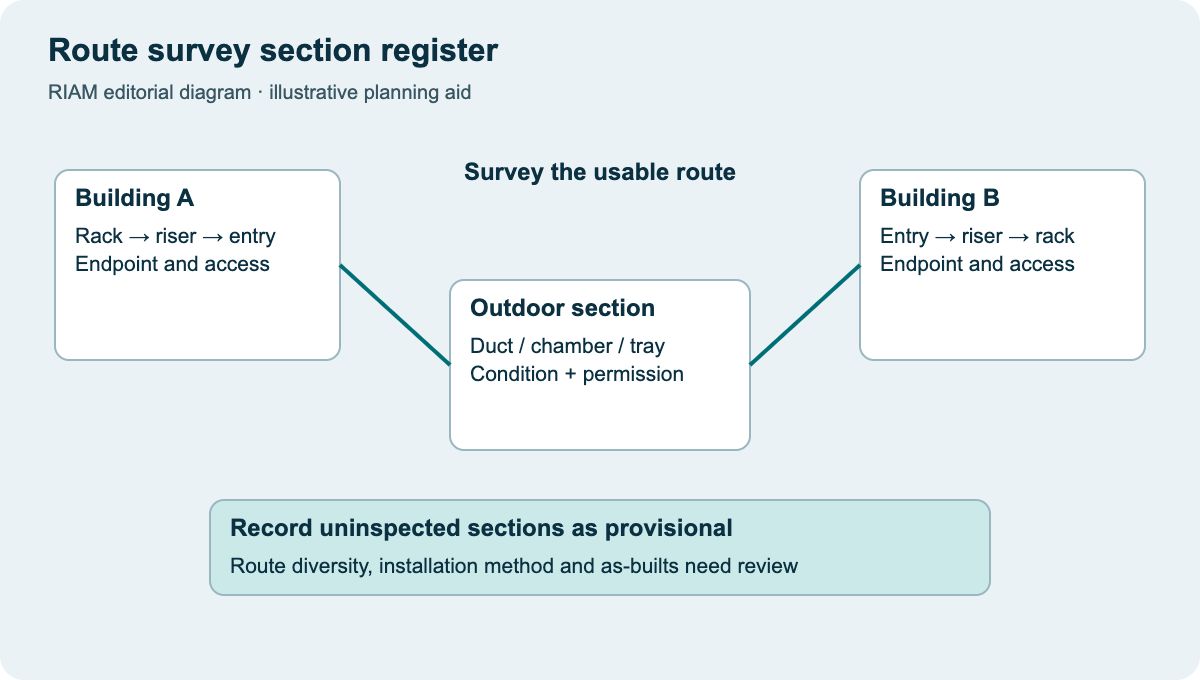
Identify the equipment room, rack, panel and access conditions at both ends. Measure to the termination positions, not merely to the outer walls of the buildings. Record the proposed path inside each building and who can authorise access.
Ask whether the link has an operational resilience requirement. Do not describe two cables on the same physical route as diverse paths. Record the actual route relationship and let the network designer decide whether it meets the business requirement.
Inspect the pathway rather than assuming it is usable
Show ducts, trays, shafts, chambers and building entries on the route sketch. Record whether each section is accessible, occupied, obstructed or awaiting investigation. Existing route drawings are useful evidence, but mark what was physically checked and what remains an assumption.
Separate the fibre installation from civil work and building reinstatement. Identify the parties responsible for duct preparation, access covers, entry sealing and any required permissions. Do not describe an unverified pathway as ready simply because it appears on an old plan.

Match the cable construction to each environment
Record outdoor exposure, wet sections, mechanical protection needs, building transitions and other conditions for the designer to assess. Choose the exact cable from those requirements rather than from a general instruction to supply “outdoor fibre”.
Belden’s FDSH048LD specifications distinguish installation bend radius from operating bend radius and provide a product-specific installation tensile limit. Belden FDSH048LD product specifications The distinction is useful during route planning: a path that fits the stored cable is not automatically suitable for pulling it in. Apply the selected product’s actual instructions; do not copy one SKU’s limits to another.
Make route quantities auditable
Break the path into labelled sections and record the measured or estimated basis for each. Keep service loops, entry arrangements and termination allowances explicit. The final quantity should be traceable to the surveyed route and agreed installation method.
If any section is inaccessible, show the provisional allowance and the event that will resolve it. Ask bidders to state the variation basis for a blocked route or a changed building entry. That is more transparent than quietly hiding the uncertainty in a metre rate.
Keep an unresolved route visible
If the planned path crosses a locked chamber, note that the section has not been inspected. Identify who will arrange access and confirm the route quantity. A provisional route can support an early estimate. However, label it clearly rather than calling it a completed survey.
Survey the handover requirements too
Record the required cable and fibre IDs, panel positions, test scope and as-built route format. Ask who will update the drawing if the installed path changes. Agree who approves exceptions before the team leaves the site.
RIAM’s fibre-cabling enquiry can start with a campus drawing, endpoint details and known pathway information. The resulting scope should make the route, responsibilities and acceptance evidence clear. Cable selection and any civil or safety-critical work must still be reviewed for the actual site rather than treated as a DIY instruction.
Route survey section register
Use this as a discussion worksheet. Edit the highlighted cells for planning, then print the worksheet. The worksheet does not save changes automatically.
| Section | Evidence / condition | Responsibility | Quote treatment |
|---|---|---|---|
| Building A rack → entry | Actual termination and access route | Confirm owner | Measured / provisional |
| Outdoor path | Duct/tray condition and permissions | Confirm owner | Included civil work / exclusion |
| Building B entry → rack | Transition, internal route and access | Confirm owner | Measured / provisional |
| Testing and as-builts | Fibre IDs; method; final route record | Confirm owner | Included deliverables |
Example values, where shown, are labelled assumptions. This is not a quotation or an engineer-approved design.
Questions buyers ask
Can straight-line distance set the cable quantity?
It is only an early estimate. The usable route, internal paths and agreed installation allowances determine the surveyed quantity.
Does outdoor cable suit every buried route?
No. Check the exact construction, environment, protection and installation method with the designer and manufacturer instructions.
Are two parallel cables resilient?
They may share the same physical risk. Record the paths and assess diversity against the business requirement.
What if a duct cannot be inspected?
Mark the section provisional and agree investigation, responsibility and the variation mechanism before treating the price as firm.
Who keeps the final route drawing?
Name the document owner in the scope and require the installed route revision at handover, with approved changes recorded.
Discuss the requirements with RIAM’s fibre services team. For background, read the existing fibre guide.
Manufacturer references
References checked on 22 October 2026. Check model details and suitability against the selected configuration.
Also read our duct-crossing planning guide.


[…] read our campus route survey and Ethernet category […]
[…] read our campus route survey and backbone compatibility […]