Copper · Buyer guide
Two contractors can quote the same number of network points and still be pricing different jobs. One includes the cable, both terminations, patch cords and certification. The other includes the cable run and leaves the rest for later. Before comparing the rate per point, agree what you will receive at handover.

Write one definition of a completed point
Describe the connection from the patch panel to the outlet, then state which patch cords, faceplates and accessories are included. Record the required cable category and the exact proposed cable, jack and panel part numbers. A brand name alone leaves too much room for substitutions. Ask each bidder to price that same definition and list every departure beside it.
Also define the measurement basis. Is the quoted rate based on an assumed average run length, a surveyed route, or actual installed metres? What happens when a desk moves to the far side of the floor? An agreed change mechanism is more useful than a very low headline rate with no length assumption.
Separate the cable from the work around it
Ceiling access, containment, drilling, reinstatement and fire-stopping can change the scope considerably. Put them on their own BOQ lines. Identify who supplies access equipment, who obtains building permission and which work needs a shutdown. A contractor cannot price an occupied floor accurately from a desk count alone.
CommScope’s Category 6A catalogue lists distinct cable families and part references. Use the proposed reference to obtain the applicable datasheet; the category label is not a substitute for the selected product’s construction and installation requirements. CommScope Category 6A portfolio The photographed 1091B cable is a product example, not a mandated brand or a RIAM supply commitment.

Make testing and documentation visible
Ask for the test method, limit and report format before placing the order. “Tested” could mean something very different from the certification package your project requires. Require a link schedule so the report identifiers match the outlet and panel labels. Record who corrects failed links and whether retesting is included.
Fluke’s DSX family is a copper certification platform with reporting tools. Fluke Networks DSX CableAnalyzer Naming a tester is still insufficient: the scope must identify the configuration, applicable limits and links to be delivered. Do not accept a photograph of a tester as evidence that every installed link passed.
Compare the whole accepted job
Use the worksheet below for each bidder. Bring optional items into the comparison only when your project needs them, and flag exclusions rather than silently treating them as free. Keep quoted amounts in INR, show whether GST is included, and record the quote date and validity. No assumed market rate is needed to make this comparison.
A useful commercial comparison is the accepted base scope plus required excluded items, access and shutdown work, testing and documentation, followed by the applicable tax treatment. Ask the bidder to confirm those additions in writing. Keep contingency separate from the contractor’s quote so your own allowance is not mistaken for a supplier price.
Send the same clarification to every bidder
When one contractor identifies a missing pathway or additional outlet, update the common scope and ask everyone to respond to that revision. Otherwise you are comparing different versions again. Keep the floor plan, point schedule and BOQ under one revision number.
For a site-specific discussion, use RIAM’s structured cabling enquiry route with your project city, floor plan, required point count and proposed work window. A survey can then establish the missing scope before anyone treats a per-point figure as a complete project budget.
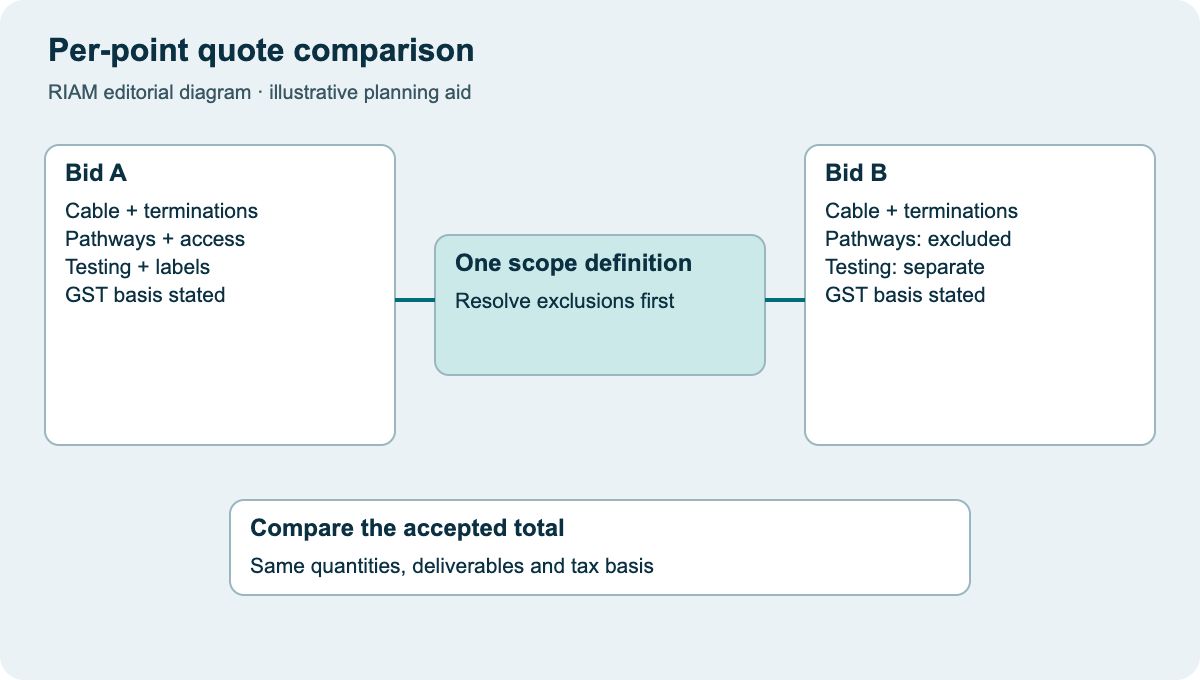
Per-point quote comparison
Use this as a discussion worksheet. Highlighted cells can be edited for your planning, then printed. Changes are not saved automatically.
| Scope item | Required definition | Bidder A | Bidder B |
|---|---|---|---|
| Cable and connectivity | Category, full part numbers, quantity and run-length basis | Enter quote reference | Enter quote reference |
| Pathways and access | Containment, civil work, ceiling access and permissions | Included / excluded | Included / excluded |
| Acceptance | Test limits, all link reports, labels and as-builts | Included / excluded | Included / excluded |
| Commercial total | INR; GST basis; shutdown charges; validity | Enter confirmed amount | Enter confirmed amount |
Example values, where shown, are labelled assumptions. This is not a quotation or an engineer-approved design.
Questions buyers ask
Does a point include both ends?
Only if the scope says so. Identify the panel termination, outlet termination and any patch cords separately so both bidders count the same completed connection.
Should I choose the lowest per-point price?
Compare the cost of the same accepted scope first. A lower rate can be valid, but an excluded pathway or test package may change the comparison.
Can a cable brand guarantee the installation?
The product name does not establish installation quality or a project warranty. Ask for exact parts, test evidence and the written warranty conditions.
How should GST appear?
Ask the supplier to state the tax basis and applicable treatment on its quote. Do not compare one tax-inclusive total with another pre-tax amount.
What if the floor plan changes?
Issue a revised point schedule and agree the variation basis before the changed work starts. Keep the revised scope with the quote.
Discuss the requirements with RIAM’s copper services team. For background, read the existing copper guide.
Manufacturer references
References checked on 22 October 2026. Model details and project suitability should be checked against the selected configuration.