Rack · Buyer guide
A cabinet can have enough rack units and still fail the fit check. The switch fits between the rails, but its rear connectors meet a closed door; or a vertical power unit occupies the space intended for cables. Before approving the cabinet size, ask for a side-view fit drawing of the complete installed arrangement.

Use three measurements, not one
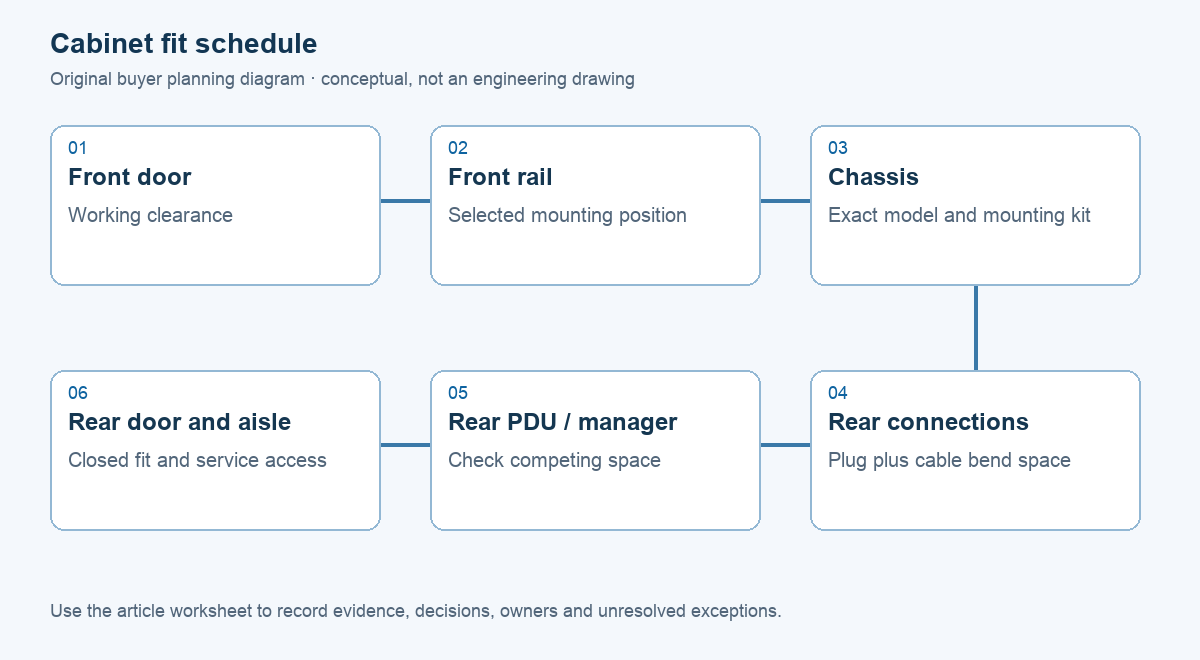
Separate the cabinet’s external depth, permitted rail positions and usable space around the selected equipment. The equipment schedule should include the chassis, mounting kit, connectors and the space required by the manufacturer for ventilation and servicing. The longest chassis is not always the item that determines the tightest rear clearance.
Panduit’s Net-Access N-Type specification lists cabinet dimensions and rail-span dimensions separately, with different configurations and accessories. That distinction is the useful procurement lesson; a nominal depth is not a promise that any device of a shorter length will fit. Panduit: Net-Access N-Type cabinet specification
Draw the installed cables and power units
Show the intended front and rear cable exits, bend requirements, vertical managers, power distribution and door position. For a cabinet with several equipment types, check each at its actual rail location. Do not fill in clearances with a universal allowance that has not been compared with the selected parts.
The Catalyst family photo is a switch reference, not a dimensioned cabinet fit drawing. Ask the bidder to attach the actual chassis and mounting-kit documents. For patch panels and fibre equipment, include the management accessories that the proposed installation requires, not just the metal front plate.

Include the route into the room
Check delivery doors, lift restrictions, turning space, raised-floor or plinth arrangements and the final service aisle. Ask which components arrive assembled and which can be handled separately under the supplier’s instructions. A cabinet that fits the room plan can still be difficult to deliver or maintain.
Have the building team review loading, anchoring and electrical requirements where applicable. Those are site design questions for the responsible parties, not dimensions a buyer should infer from a catalogue picture. Keep each exclusion and approval owner visible in the purchase order.
Make fit a documented acceptance item
Request a drawing or fit confirmation tied to the final bill of materials. If a chassis, power unit or accessory is substituted, repeat the affected fit review before delivery. Record whether doors close without stressing cables and whether routine service tasks remain possible.
For a RIAM cabinet assessment, send the current equipment list and photographs with known measurements. The practical output is a coordinated arrangement with stated constraints, not a generic instruction to buy the largest cabinet or a promise that a particular rack-unit count solves every layout problem.
Cabinet fit schedule
Use this worksheet in the supplier discussion. Replace example entries with your project information; it is not a completed survey or approved design.
| Check | Required input | Record before ordering |
|---|---|---|
| Equipment mounting | Exact chassis and rail kit | Permitted rail span |
| Rear connections | Connector, cable and bend requirement | Usable rear space with door closed |
| Side space | PDU and manager positions | No conflict with equipment/service access |
| Delivery and maintenance | Room route and service clearances | Access limits and owner approvals |
Questions buyers ask
Does rack-unit count prove a cabinet will fit?
No. Rack units describe vertical mounting space; depth, width, load and access also matter.
Is external depth the usable equipment depth?
No. Rails, doors, connectors and accessories change usable space.
Can the PDU be added later without review?
Check its actual position; it may compete with cabling or equipment access.
Should a substitute switch trigger another check?
Yes, if its dimensions, airflow, connectors or mounting arrangement differ.
Does this article specify safe electrical or structural work?
No. Responsible qualified parties must assess site-specific loading, anchoring and electrical provisions.
Discuss your requirements with RIAM’s rack team, or send a project brief. Scope, availability and commercial terms are confirmed in the project proposal.
Manufacturer references
Research checked 24 October 2026. Use the exact selected model, release and applicable project documents.
Also read our rack elevation planning and network rack basics.