Rack · Buyer guide
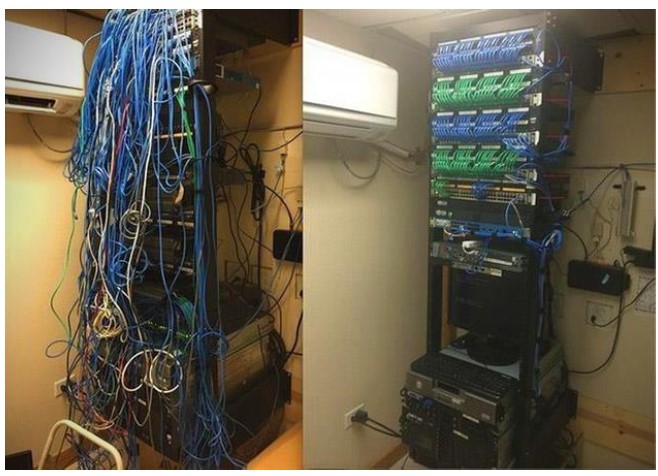
A photograph can show tangled patch cords. It cannot show every live dependency, access restriction or cable that needs replacement. If you are budgeting a rack dressing job, begin with work packages and quantities. A single price per rack can hide very different amounts of work.

Count what is changing
Record the rack ID, occupied equipment, connected ports, existing cable managers and the current state of the labels. Separate cables that need a new route from cords that need replacement, and distinguish patching work from permanent cable retermination.
That distinction matters commercially. Replacing a patch cord, moving a patch panel and relocating a switch should not disappear into the same unexplained labour line. Ask the contractor to identify its unit basis and the assumptions behind it so a revised port count can be priced consistently.
Price discovery before promising the finished result
Unknown connections need investigation. Decide whether that discovery is part of the quoted survey, an agreed allowance or a separate stage before the final price. Identify who can confirm service ownership and provide configuration information.
If the rack contains critical services, include planning, approval and validation time. An after-hours work window may involve different access and staffing arrangements. State those conditions openly rather than assuming that all physical work can happen in the cheapest available hours.

Specify materials by function and reference
List replacement patch cords by type and required length, then identify labels, horizontal or vertical managers, mounting accessories and any necessary consumables. Record what can be reused after inspection. A materials list should support the planned routing, not simply fill the rack with accessories.
Panduit’s NetRunner specification includes bend-radius features in its cable-manager design. Panduit NetRunner vertical manager specification Use the relevant manufacturer documentation when selecting parts. This does not make every manager interchangeable or prove that an accessory will fit the existing cabinet, door clearance and cable load.
Use a budget that exposes assumptions
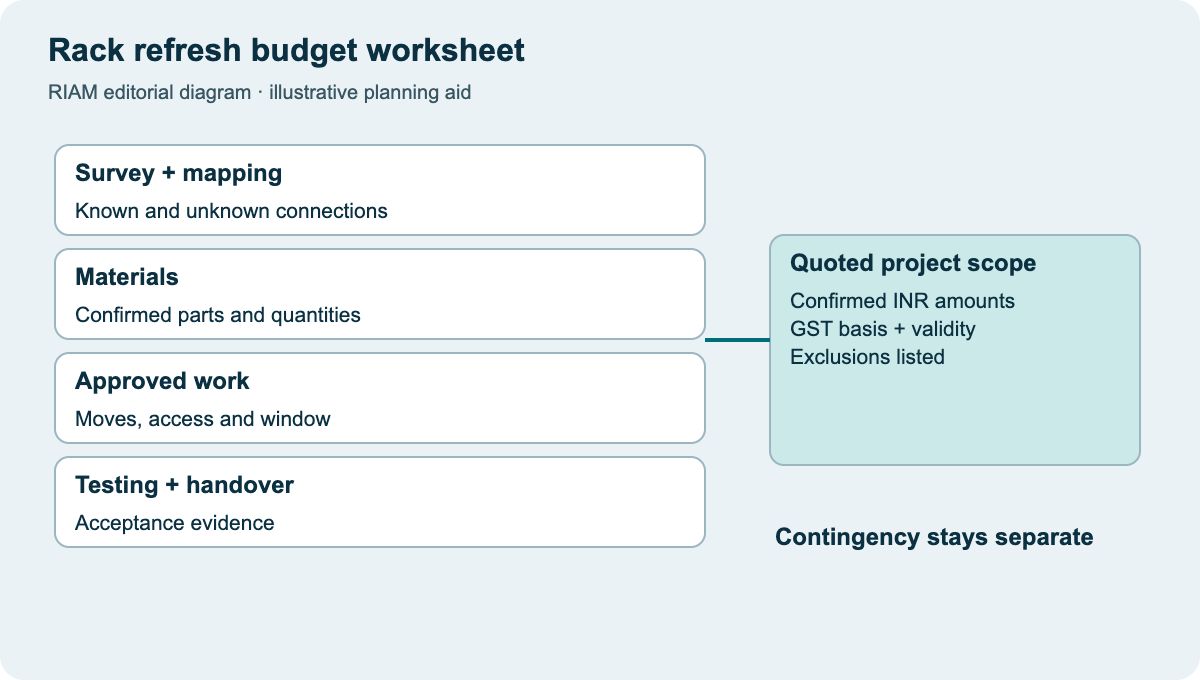
The worksheet separates survey and mapping, approved physical changes, materials, testing and handover, and access-related costs. Enter supplier-confirmed amounts in INR. Keep GST treatment, quote validity and exclusions visible. No rupee rate in this draft is presented as a market price.
Your internal contingency belongs on a separate line with its owner and purpose. It should not be added to a supplier figure and then described as the supplier’s quote. Where the scope is not known, record the quantity or decision needed instead of giving an unsupported total.
Keep optional changes optional
If the survey reveals a possible switch relocation, list it as a separately defined option rather than allowing it to expand the agreed dressing job silently. The option needs its own service dependencies, price and approval. That keeps an attractive rack layout from becoming an unplanned network migration.
Compare the same acceptance outcome
Ask what you will receive at the end: updated port map, labels, agreed tests, as-left photographs and an exception list. Define who signs off the application checks and what happens if the work cannot be completed inside the approved window.
For RIAM’s rack-refresh service, provide current photographs and the best available connection map. The website reference image shown here is not a priced sample project. Its original project details need confirmation before any case-study claims. A useful budget explains what the team will do, how completion will be checked and which conditions can change the amount.
Rack refresh budget worksheet
Use this as a discussion worksheet. Highlighted cells can be edited for your planning, then printed. Changes are not saved automatically.
| Work package | Quantity / assumption | Confirmed INR amount | Tax / exclusions |
|---|---|---|---|
| Survey and mapping | Racks, ports, unidentified services | Enter supplier amount | State basis |
| Materials | Part references, lengths and quantities | Enter supplier amount | State basis |
| Approved change work | Moves, retermination and work window | Enter supplier amount | State basis |
| Testing and handover | Defined evidence and service checks | Enter supplier amount | State basis |
| Internal contingency | Owner-approved risk allowance | Enter separate allowance | Not a supplier quote |
Example values, where shown, are labelled assumptions. This is not a quotation or an engineer-approved design.
Questions buyers ask
Can a photo produce a firm price?
It can support an initial discussion. A reliable scope also needs quantities, service dependencies, access and acceptance requirements.
Why separate mapping from dressing?
Finding unknown services is different work from routing identified connections. Showing it separately makes the uncertainty visible.
Should all patch cords be replaced?
Not automatically. Decide from condition, compatibility, route and required lengths, then list the replacement quantities.
Are shutdown costs always extra?
That depends on the contract. Ask for the included window and any separate access, staffing or extension charges.
Does a tidy rack prove the job is complete?
The owner still needs the agreed labels, connection records and service checks. Appearance is only one part of acceptance.
Discuss the requirements with RIAM’s rack services team. For background, read the existing rack guide.
Manufacturer references
References checked on 22 October 2026. Model details and project suitability should be checked against the selected configuration.