
Rack · Buyer guide
The rack doors close, the new labels look consistent and the after photograph is ready. Before closing the job, choose a connection and follow it through the records. Does the outlet label match the panel, the patching schedule and the agreed switch port? That simple question exposes gaps a photograph cannot.

Agree the naming rule before checking the labels
Record how room, rack, panel and port identifiers are structured. Make sure the scheme distinguishes similar equipment on different floors or in different buildings. A neat label reading “Port 12” may still be ambiguous outside its immediate rack.
Assign one owner for the final naming rule and record approved exceptions. If the refresh changes an existing identifier, retain the old-to-new cross-reference. That helps the support team interpret historic tickets and test reports without guessing which connection was renamed.
Reconcile physical and documented connections
Use the worksheet to compare the endpoint, panel position and patching record. Add the live switch position and service owner where those are part of the agreed scope. Keep physical-link identity separate from a service assignment that may change later.
A sampled walk-through can reveal problems, but it should not be reported as a full check of every connection. Define whether the contract requires complete reconciliation or an agreed sample, and record exactly what was checked. Escalate unexplained mismatches instead of making the labels match an unverified spreadsheet.

Check maintainability as well as appearance
Verify that the agreed labels remain readable and the route does not obstruct the access needed for ordinary maintenance. Ensure covers and doors operate with the actual cable arrangement. Record the manager references and any constraints relevant to future additions.
Panduit’s NetRunner specification describes routing features designed to support bend-radius control. Panduit NetRunner vertical manager specification Those product features are useful context, but acceptance concerns the installed arrangement. A brand-labelled manager does not prove that the cables inside it were routed or identified correctly.
Keep service checks tied to the change
Use the approved migration list to identify which business services need validation after the refresh. Record the test, result, time and owner. If the work changed configurations or physical terminations, include the corresponding approved evidence.
Do not combine every check into one unexplained “pass”. Label reconciliation, physical cable testing and application validation answer different questions. A failed item should identify the connection and responsible party so it can be corrected and rechecked without repeating the whole job blindly.
Make exceptions useful to support
An open exception should contain enough information for another engineer to act: the connection ID, observed mismatch, current service state, required correction and responsible person. Avoid a note such as “labels pending” with no affected range. Precise exceptions allow a limited acceptance decision without losing track of unfinished work.
Sign the as-left record with visible exceptions
Save the final port map, relevant reports, before/after photographs and exception list together under a revision date. Include blank or reserved positions, removed items and unresolved connections with their actual status. The support team should not have to infer whether an empty row means free, unknown or outside scope.
This draft uses the rack image already displayed on RIAM’s service page as a review reference only; it does not introduce a new customer success claim. When reviewing a RIAM rack-refresh scope, agree the reconciliation coverage and acceptance owner before work begins. The final sign-off should establish what the records represent, what was tested and what remains open.
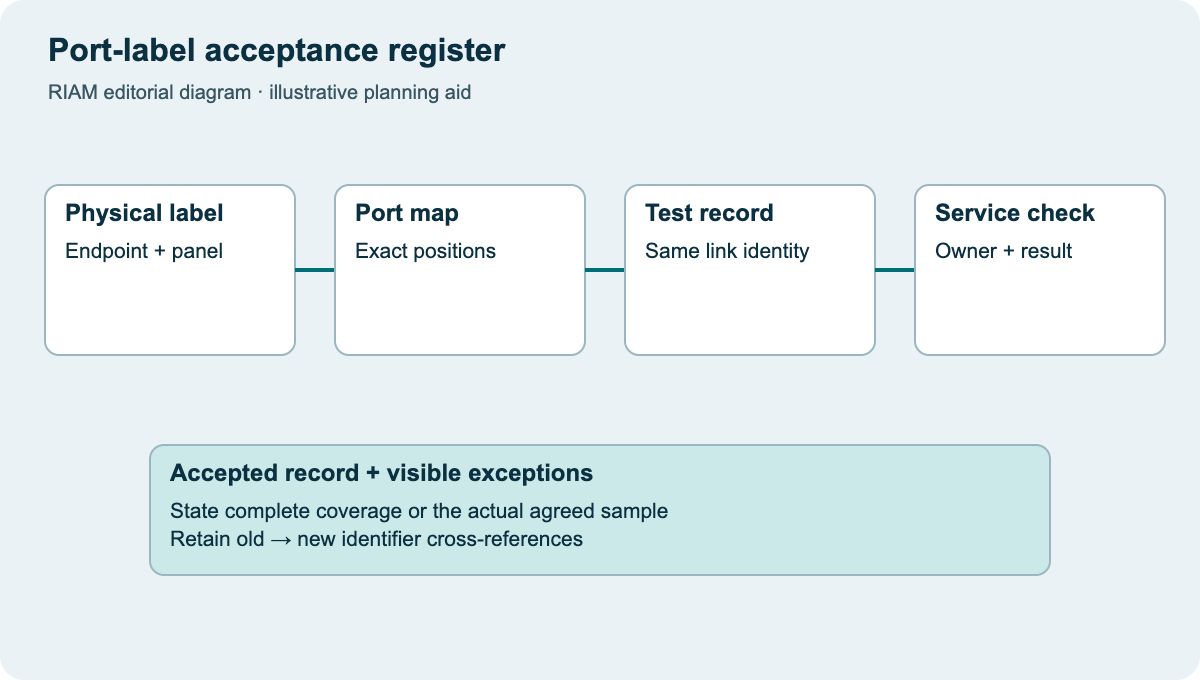
Port-label acceptance register
Use this as a discussion worksheet. Highlighted cells can be edited for your planning, then printed. Changes are not saved automatically.
| Connection ID | Physical label / map match | Service evidence | Accepted / exception |
|---|---|---|---|
| Enter endpoint and panel ID | Checked against actual positions | Test / owner / time | Record result |
| Renamed connection | Old ID → new ID reference | Historic record cross-reference | Record result |
| Reserved / empty position | Mark reserved, free or out of scope | No implied live service | Record actual state |
| Unresolved item | Mismatch and corrective action | Owner and due date | Keep open until rechecked |
Example values, where shown, are labelled assumptions. This is not a quotation or an engineer-approved design.
Questions buyers ask
Can an after photograph be the acceptance record?
It supports the record but cannot establish every endpoint or service. Keep the agreed port map and validation evidence alongside it.
Is checking a sample the same as checking every port?
No. Record the actual coverage and use the acceptance approach agreed in the scope.
Should labels show the switch port?
Define the scheme with the owner. Keep durable physical-link identity distinct from service assignments that can change.
What happens when the map and rack disagree?
Investigate the connection and establish the correct record before relabelling. Keep the discrepancy open until it has been resolved and rechecked.
Who should approve the final record?
Name the technical and business acceptance roles in advance. The people responsible for maintaining and validating the services should receive the final package.
Discuss the requirements with RIAM’s rack services team. For background, read the existing rack guide.
Manufacturer references
References checked on 22 October 2026. Model details and project suitability should be checked against the selected configuration.
Also read our rack hotspot investigation and live-port migration plan.

[…] Also read our rack before-and-after gallery and port-label acceptance checks. […]
[…] read our port-label acceptance checks and rack-dressing budget […]