wired 802.1X · Buyer guide
A wired 802.1X rollout should start with a device inventory and a controlled pilot. A network-access project can stall on printers, phones and appliances that behave differently from managed laptops. Before buying a site-wide rollout, ask for a device-class pilot and an explicit exception policy. The business decision is how access will be controlled without losing essential services.

Wired 802.1X: inventory endpoint classes
Group endpoints by ownership, management method, identity capability and service criticality. Include shared devices and equipment maintained by third parties. Cisco’s campus guidance discusses authenticated network access; the procurement scope still needs the organisation’s actual identity and operational requirements. Do not let “all endpoints” conceal an unknown population.
Agree the failure and exception behaviour
Ask the designer to describe what happens when authentication fails, the identity service is unavailable or a device cannot use the preferred method. Assign a risk owner and expiry to exceptions. A temporary bypass should not become the undocumented default. Define the service desk’s diagnosis and escalation path before staff are affected.

Use a bounded pilot with rollback authority
Select representative device classes, locations and support periods. Record expected access, observed result and recovery steps. Keep changes under an approved window and give a named person stop authority. Expand only after unresolved exceptions have owners and the support team can distinguish identity failure from a physical network fault.
Wired 802.1X: pilot worksheet
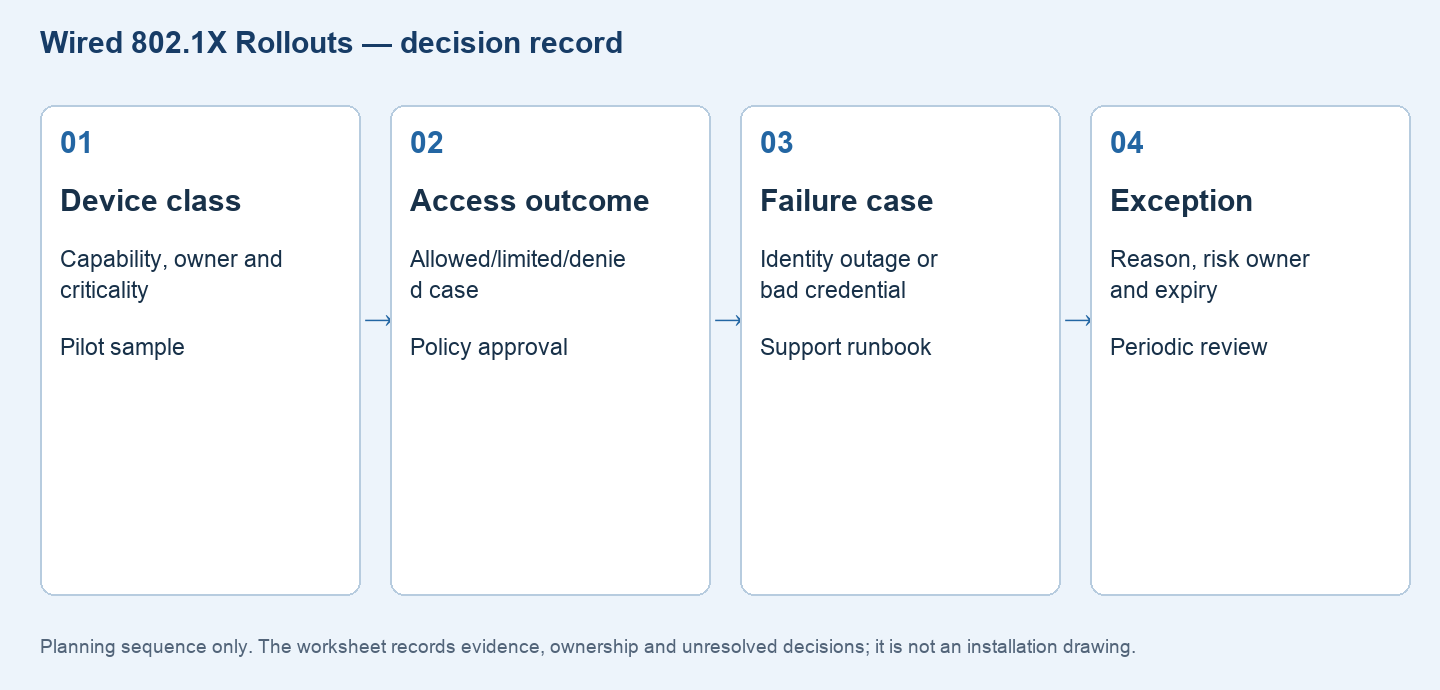
Use the rows below to compare proposals. Enter the actual evidence reference, accountable owner and unresolved decision against each item. Keep provisional assumptions visible when asking bidders to revise their prices.
| Decision | Evidence to request | Purpose |
|---|---|---|
| Device class | Capability, owner and criticality | Pilot sample |
| Access outcome | Allowed/limited/denied case | Policy approval |
| Failure case | Identity outage or bad credential | Support runbook |
| Exception | Reason, risk owner and expiry | Periodic review |
Questions buyers ask
Should every device use the same method?
Let the responsible design assess capabilities and policy. Record approved alternatives rather than assuming uniform support.
Is an exception list a permanent bypass list?
It should have named ownership, a reason and review or expiry conditions.
What makes a good pilot?
Representative endpoint classes, explicit expected access, controlled changes and a practical recovery process.
Should the help desk be involved?
Yes. Staff need enough evidence and a runbook to identify and route authentication incidents.
Does this article provide configuration commands?
No. It defines a buying and acceptance scope; implementation must follow the reviewed product and security design.
Manufacturer research and scope
Cisco: campus LAN and wireless design guide, reviewed 31 October 2026. The buying worksheet is RIAM editorial analysis; it is not an OEM-approved design. Confirm current product, software, support and local requirements for the selected bill of materials.
Brief RIAM with the evidence
Share the existing inventory, the specific service or buying decision, available records and access constraints with RIAM’s security services team. Ask for a scoped assessment with deliverables, responsibilities, exclusions and acceptance evidence. Site work and production changes require the responsible owners’ approved plan.
Also read our wireless access management and managed-switch selection.