OS2 or OM4 · Buyer guide
An OS2 or OM4 decision should compare the complete fibre link and its intended applications. Choosing a fibre grade by cable price alone can hide the cost of the optical interfaces and a future change. Ask bidders to compare a complete application over the measured route. Keep today’s confirmed requirement separate from a possible upgrade that has not yet been designed.

OS2 or OM4: define the application
Record the intended link rate, exact interface options, usable route length and connection points. A fibre label is only one input to compatibility. Fluke’s data-centre material discusses cabling as part of the connection. Ask for an application-specific explanation of suitability rather than a blanket statement that one grade is always more future-proof.
Build a comparable system cost
Include optics, panels, patching, testing and operational spares for each proposal. Identify any existing equipment or cabling the design assumes will be retained. Show the upgrade scenario separately, with its interface and fibre-count assumptions. Avoid counting hypothetical savings as certain when the next application or hardware choice remains undecided.

Keep the decision reversible where practical
Ask what would have to change if the future application differs: transceivers, patching, termination or installed cable. Record spare pathways and documented constraints without promising unlimited reuse. At handover, preserve the fibre identity and the accepted application so the next procurement team can assess changes from evidence.
OS2 or OM4: comparison worksheet
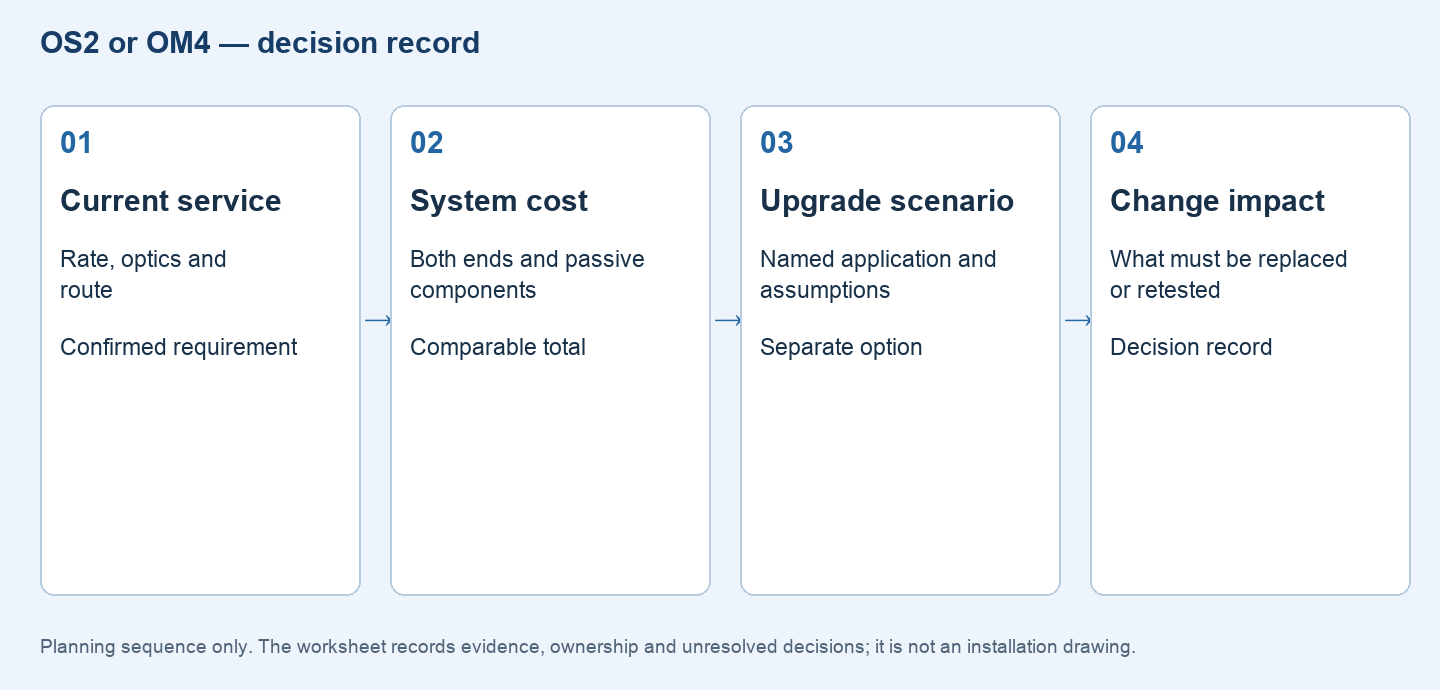
Use the rows below to compare proposals. Enter the actual evidence reference, accountable owner and unresolved decision against each item. Keep provisional assumptions visible when asking bidders to revise their prices.
| Decision | Evidence to request | Purpose |
|---|---|---|
| Current service | Rate, optics and route | Confirmed requirement |
| System cost | Both ends and passive components | Comparable total |
| Upgrade scenario | Named application and assumptions | Separate option |
| Change impact | What must be replaced or retested | Decision record |
Questions buyers ask
Is OS2 always cheaper overall?
Not necessarily. Compare the selected optical interfaces and complete installation for the actual application.
Does cable colour prove fibre identity?
Use manufacturer and installation records, supported by appropriate verification, rather than colour alone.
Can we promise every future speed?
No. Future compatibility depends on the chosen application, interfaces, route and component arrangement.
Should existing optics be part of the brief?
Yes. Their exact models and support constraints can change the viable options.
What is the useful output of the comparison?
A documented current design plus clearly labelled future scenarios, costs and unresolved assumptions.
Manufacturer research and scope
Fluke Networks: data-centre cabling and connectivity, reviewed 31 October 2026. The buying worksheet is RIAM editorial analysis; it is not an OEM-approved design. Confirm current product, software, support and local requirements for the selected bill of materials.
Brief RIAM with the evidence
Share the existing inventory, the specific service or buying decision, available records and access constraints with RIAM’s fibre services team. Ask for a scoped assessment with deliverables, responsibilities, exclusions and acceptance evidence. Site work and production changes require the responsible owners’ approved plan.
Also read our single-mode and multimode comparison and fibre cable buying guide.