switch stacks · Buyer guide
Switch stacks need a clear explanation of maintenance events and shared failure boundaries. A stack can simplify management, but a proposal should still explain its maintenance and failure boundaries. Before approving the design, ask which users and services can be interrupted by a member replacement, software event or shared dependency.

Switch stacks: identify shared dependencies
Record switch models, software, stack arrangement, uplinks and power dependencies. Cisco Meraki documents several stacking types and model-specific requirements. Do not assume that one product family’s operational behaviour applies to every other stack. Ask the supplier for the current supported design and the limitations relevant to the chosen equipment.
Review maintenance scenarios as well as failures
Separate a member loss, stack-link issue, planned upgrade and device replacement. The engineer should state expected service impact and the evidence supporting it. A claim of redundancy is incomplete without the affected endpoints and shared dependencies. Include services that use one physical member even when management is presented as a single logical system.

Buy a controlled operating runbook
Require prerequisites, approved windows, recovery responsibilities and verification steps for the agreed scenarios. Any demonstration should use an authorised plan that protects live services. Retain the final inventory and topology after changes. The acceptance goal is understood operational behaviour, not an unqualified zero-downtime promise.
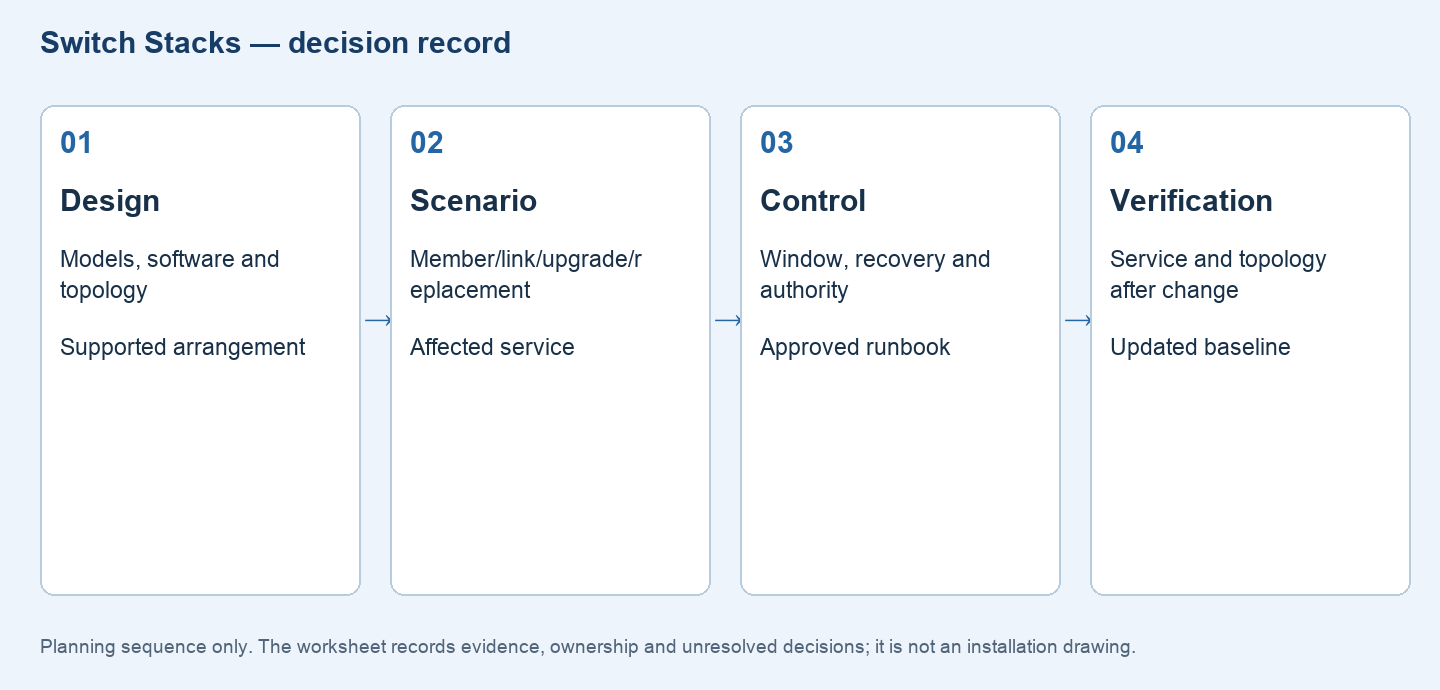
Switch stacks: maintenance worksheet
Use the rows below to compare proposals. Enter the actual evidence reference, accountable owner and unresolved decision against each item. Keep provisional assumptions visible when asking bidders to revise their prices.
| Decision | Evidence to request | Purpose |
|---|---|---|
| Design | Models, software and topology | Supported arrangement |
| Scenario | Member/link/upgrade/replacement | Affected service |
| Control | Window, recovery and authority | Approved runbook |
| Verification | Service and topology after change | Updated baseline |
Questions buyers ask
Does stacking guarantee uninterrupted service?
No. Review the selected platform, topology and event; some operations can affect attached services.
Can every model join the same stack?
Check the manufacturer’s current compatibility and supported arrangement for the exact equipment.
Should a replacement be demonstrated?
Agree a safe test or documented evidence appropriate to the service risk and available environment.
Are dual power feeds enough?
They address only part of the dependency picture and need their own verified design and ownership.
What should RIAM quote?
The chosen equipment design plus defined maintenance scenarios, operating documentation and acceptance evidence.
Manufacturer research and scope
Cisco Meraki: switch stacks, reviewed 31 October 2026. The buying worksheet is RIAM editorial analysis; it is not an OEM-approved design. Confirm current product, software, support and local requirements for the selected bill of materials.
Brief RIAM with the evidence
Share the existing inventory, the specific service or buying decision, available records and access constraints with RIAM’s network services team. Ask for a scoped assessment with deliverables, responsibilities, exclusions and acceptance evidence. Site work and production changes require the responsible owners’ approved plan.
Also read our switch support-date register and configuration restore handover.